Showing posts with label history. Show all posts

Tuesday, August 10, 2021

"April 1865: The Month That Saved America"

Most people know that Lincoln was assassinated in April 1865, and that Lee surrendered to Grant at Appomattox that same month. It was the beginning of the end of the Civil War.

What most people don't know (but I learned from Jay Winik's excellent book, April 1865: The Month That Saved America) is that the military and political leadership of both the Union and the Confederacy were involved in momentous decisions in April that helped bring the war to an end, and bring the country back together. These were decisions that, had they been made differently, could've resulted in catastrophe for our nation. Even if the Union had won the war, and the South readmitted, our identity as a unified country might have been in jeopardy had these decisions been made differently. 

As Winik points out, using contemporary examples, some countries and regions never fully recover from civil wars. To increase the probability of long-lasting peace, Lincoln and Grant chose to disregard the railings of those who would bring shame and severe punishment on the heads of their conquered enemy. Though Jefferson Davis was all for a last-ditch attempt at preserving the Confederacy by sending the army into the hills for prolonged guerrilla warfare, Lee chose the high road, knowing the impact of a sustained war would only make matters far worse than they already were. Winik covers both the strengths and faults of Lincoln, Grant, Lee, Sherman, Johnson, Davis, and Forrest, and shows that, despite these faults, they made the decisions at the end of the war that enabled the U.S. to come back together.

The only thing I wish Winik had not omitted was a discussion of Lincoln's presidential pardons for high-ranking Confederate officers and officials, and how that played out with Andrew Johnson once he assumed the presidency. I believe Lincoln's policies in this regard played an important role in achieving peace, and Johnson's policies almost aborted this.

For a different but equally engaging account of events in April and May 1865, I highly recommend James L. Swanson's Bloody Crimes: The Chase for Jefferson Davis and the Death Pageant for Lincoln's Corpse.

Tuesday, July 27, 2021

Four Ministers and a Confederate Colonel

In a recent post I explained how network science shows that any two arbitrary people in the world may be more closely linked, through a chain of social connections, than one might expect. In exploring the history of my great-great-grandfather Second Lt. Andrew Jackson Lacy's service in Tennessee's Confederate cavalry, I discovered a chain of associations among army chaplains, ministers, and the commander of Lieutenant Lacy's regiment.

The Needs of Body and Soul

In a letter he wrote a month after joining Tennessee's Confederate cavalry, Lieutenant Lacy spoke of going to church and hearing "Dr. Pendergrass" preach. The chaplain of Lacy's regiment, the Eighth Tennessee Cavalry, was Charles Wylie Witt, a minister of the Cumberland Presbyterian Church. "Parson" Witt's nephew, Travis Witt Pendergrass, actually accompanied this regiment for several months, attending to the needs of both body (surgery) and soul (exhortation). Like his uncle, Pendergrass was a minister of the Cumberland Presbyterian church. His three younger brothers were all in the same company as Lieutenant Lacy. (1)

Reconnected in the Middle of War

A few months after Lieutenant Lacy heard Pendergrass preach, the Eighth Cavalry was sent to Florence, Alabama.  There Pendergrass was surprised to run into a fellow Cumberland Presbyterian minister, Thomas Fletcher Bates.  Then, to his further surprise, he encountered Rev. R. A. Young, a prominent preacher in the Methodist Episcopal Church, South, currently serving as president of the Wesleyan University in Florence.  Pendergrass had met Young in Lebanon, Tennessee in 1853, shortly before Young was reassigned to a pastorate in St. Louis, Missouri. (2)

A Confederate Colonel

In 1846, Reverend Young had met the "plain, quiet" son of his friend, Anthony Dibrell. That son, George Gibbs Dibrell, was now a colonel commanding the Eighth Tennessee Cavalry. Of Colonel Dibrell's religious convictions, Young said "When his [Dibrell's] chaplain preached to his command, standing between two tallow candles, one of his most devout listeners was the commander in chief."  The chaplain he refers to is most likely Charles Witt. (3)

And the Lacy Family Is Indebted to Chaplain Charles Witt

Before Lieutenant Lacy's regiment returned to Tennessee from Alabama, Charles Witt resigned as chaplain, complaining that the varicose veins in his legs made riding a horse very uncomfortable. Pendergrass signed off on a medical discharge for his uncle. When Witt left Florence for Jackson County, Tennessee, he delivered to Lacy's family an accounting that Lieutenant Lacy had kept of all the operations of the Eighth Cavalry up to that point. The family owns that document today. (4)


(1) Lacy, Mark E. MISSING IN ACTION, 1863: Lieutenant Andrew Jackson Lacy and Tennessee's Confederate Cavalry. 2019.

(2)Pendergrass, T. W. to Nancy Pendergrass, 15 March 1863. http://freepages.genealogy.rootsweb.ancestry.com/~pendergrass/pics/travis/pics_travis.html 

(3) Young, R. A. Reminiscences. Nashville, Tennessee: Publishing House Methodist Episcopal Church, South, 1900. https://readux.library.emory.edu/books/emory%3A7sv2p/pdf/

(4) Lacy, Mark E. Battlefront and Homefront: The Lacy Family's Civil War Documents. 2020.

Tuesday, July 20, 2021

Murder and Mayhem: When In-Laws are Out-Laws


Jube Lee Whitson (left) and unknown person,
location unknown, before 1935. (Courtesy of Ed Mason).
From a young age, my great-aunt's brother-in-law was a criminal. In time, Jube Whitson would be convicted of murder and sent to prison, then eight years later escape from prison, and two years later, be killed rather than be taken prisoner again.

Early life

Jube Lee Whitson was born July 20, 1888. At age 16 he was working at the Harley Pottery in Nashville, Tennessee, where my great-grandfather, William Woolsey Lacy, also worked. Jube was only 17 when he married Sallie Rawley in Jackson County, Tennessee. Justice of the Peace John P. Mayberry, a neighbor and Confederate veteran, officiated. And by age 19, Jube was a young father on the run from the law. My great-grandmother (Martha Jane Lacy) wrote in a letter to her son, Edward Jackson Lacy, in January 1908:

"Jube Clinton Jim Flat is [illegible]. Well tha say the government has ofered hundred dolars reward for Jube. But I tell Alvin [Lacy] the sed about Jube is the best for he is mean. He come over here to see if he cood get Alvin to take him to the [Cookeville] depo. He sad he had him to the place where you are. He sed you coud go thare on the train to where you are [Eureka, California]. If Jube ever comes out thare dont hav now use for him. Tha say that have teliphone to ever station so he cant pass but he may slip thru."

A week or two later, Thomas H. Byers, a cousin to Jackson Lacy who lived in San Francisco, wrote Jackson, saying:

"I got a letter from F. D. Byers the other day. He was teling me all a bout Jube Whitson. It would be a good thing if tha could cetch him and stop his way of geting a long in this world."

In June 1908, Tom Byers' brother, W. A. Byers in San Francisco wrote Jackson Lacy, saying

"Jub Whitson cut a gut [expression derived from when a hunter or farmer does a poor job of dressing an animal] dident he? I told Anderson Byers when he was here that Jub was dangeres and I was a fraid of him."

Little is known about Jube's service in the "Great War" (World War I). He registered for the draft on June 5, 1917, while he was in Denver, Colorado. A year later he shipped out as a private in the 46th Engineers, Co. C, leaving from Hoboken, New Jersey aboard the Sierra. Four months later, the war ended. Whatever self-discipline Jube might have picked up in the military was not enough to keep him out of future trouble.

Earning a reputation for ruthlessness

Even when Jube was in the neighborhood, people were reluctant to turn him in. They were probably afraid of what he'd do to them once he got out of jail. One time Jim (James Isaac) Flatt was taking a wagonload of railroad crossties to Cookeville when Jube stopped him to catch a ride. Jim began to tease Jube, saying he could turn him in and collect the reward. In response, Jube cut Jim's throat and threw him off in a ditch, leaving him for dead. Jim's brothers got their guns and went after Jube but failed to find him.

Jim Flatt recovered, but from that day on, folks called him "Cutthroat Jim."

Convicted and sent to prison

By the early 1920s, Jube Whitson had divorced his first wife Sallie and moved to Oklahoma. Whitson's crimes have never been completely chronicled, but the one that sent him to prison was the murder of his second wife, Ada. (Adah Larkins Whitson.)

Jube and Ada had moved to Muskogee in the summer of 1925. Pauline Binkley, age 28, had worked as a housekeeper for the Whitsons while they lived in Tennessee, and she accompanied them when they moved.

The killing of Ada Whitson took place on September 20, 1925, a few miles east of Muskogee. Jube and Ada were sharing a picnic and hunting in Cherokee County, Oklahoma, when, as Jube claimed, he tripped and fell and his gun went off, killing his wife. Investigations began immediately. On the evening of September 30, Pauline Binkley confessed to officers at Tahlequah, the county seat for Cherokee County, that she knew Jube wanted to rid himself of his wife. Pauline said she helped Jube obtain the gun he used to kill his wife, knowing what Jube planned. Jube denied this, of course.

But Ada's family was not buying that explanation. They pressed the law for justice.

While Jube Whitson remained in the Cherokee County Jail, officials grew nervous. The jail was not considered a particularly secure one, and they feared Whitson would try to escape.

The Cherokee County court worked feverishly to clear its docket before the Christmas holidays, holding nightly sessions to make that happen. Jube's murder trial only took a few days. The prosecution claimed that Jube was accused of slaying his wife Ada to marry Pauline, and to collect the life insurance on Ada. Counsel for both sides in the case finished their closing arguments at 3 AM on a Tuesday morning. Jube was convicted of first degree murder, and Pauline was convicted of being an accessory to the crime. Each of them were given life sentences and sent to the maximum-security state prison in McAlester, Oklahoma. New Year's Day, 1926, would be Jube Whitson's first full day in prison.

Escape!

For some reason, after the lovers had served several years of their sentences, someone pressed for more details on the murder. Pauline Binkley was brought before the Pardon and Parole Board at the state prison. She was told the Board was inclined to consider clemency for her if she cooperated in providing details about the murder. But all Pauline could say was, "I don't know anything about the shooting of Mrs. Whitson except the things I was told." Parole was denied.

Parole was highly unlikely to be a part of Jube Whitson's future. The only way he would see the outside of a prison would be by escaping. It took some time for Jube to find a way to break out of prison. With the help of his son, Fred, Jube planned his escape. 

Jube's escape took place on September 11, 1933. According to Ray Flatt, after serving eight years of his life sentence, Jube was outside the prison on a work detail one day when he got down on his knees, pretending to look at something. When the guard knelt to see what Jube was looking at, Jube hit him over the head and ran. Fred was waiting, and when he got the signal from his father, he drove by and picked him up. The two returned to Middle Tennessee.

In 1932 and 1933, the U.S. Bureau of Investigation began publishing personal details to help in finding and identifying fugitives. Jube Whitson was described as being about 5'10" in height, 151 1/2 pounds, medium build, gray-black hair, green eyes, and a medium complexion. He had three vaccination scars on his upper left arm, while on his right arm he sported tattoos of a nude woman, a sailor, an American eagle, a flag, and a wreath. His residence was listed as Muskogee, Oklahoma; his occupation, florist; and nationality, American.

Jube spent the next two years in hiding, but people would still see him in public. One person who saw him was my uncle, Wesley Flatt, a great-nephew to Cutthroat Jim. Wesley was only a young boy when he and his father, Ermon Flatt, were walking in the woods one day after Jube's return. As they came around the curve of an old wagon road, they met Jube walking the other way. As Jube approached them, he brought his shotgun down from his shoulder, perhaps as a precaution, but perhaps to intimidate whomever he encountered. But when he saw it was Ermon Flatt and his boy, he said, "Good morning, gentlemen," and put his gun up again. Some folks believed Jube might have been hiding out in one of the big caves nearby.

Jube Whitson is killed

In June 1935, Jube met his end. Acting on a tip from someone living in the countryside of Putnam County, Tennessee, the law caught up to Jube.

Early on a Friday morning, the transfer agent for the Oklahoma prison and two deputy sheriffs from Putnam County waited beside a corn field seven miles northwest of Cookeville. Jube had been living with Ras and Hazel Rippetoe. Hazel was a cousin to Jube. Jube always carried a semi-automatic pistol, for, as he had told relatives on more than occasion, he would never be taken back to Oklahoma alive and any officer attempting to arrest him would have to beat him to the draw. 

The lawmen had left Cookeville at 1:15 AM and silently made their way to the Rippetoe farm, where they concealed themselves in the tall grass. They were prepared to wait all day, if necessary, for their chance to apprehend Whitson. But the day had just begun when they were presented with an opportunity.

At 6 AM, Jube and three of the Rippetoe children--Doyle (age 16), Audrey (age 14), and Willard (age 11)--were chopping out corn. Working this early in the morning was easier than working in the heat of a summer day. When Jube came near enough, the officers leapt up, demanded his surrender, and told him to raise his hands. Jube wasn't about to be captured, though. He tried to draw his gun, a German Luger. The transfer agent fired two blasts from his shotgun. One of the deputies fired his shotgun into the air over Whitson's head, and took another shot at Whitson's hand, hoping that would prevent Whitson from drawing his pistol.

Whitson fell, mortally wounded in his left breast. The officers sent the Rippetoe children to tell their parents what had happened. The children also watched over Whitson's body until an ambulance from Cookeville could arrive to recover the body. Whitson was buried in the Morgan Pippin Cemetery on the Gainesboro Road in Putnam County.

Ironically, Jube's death certificate showed him as "widowed." (True, but he was responsible for becoming widowed.)

Some different details of a desperado's demise

As with many examples of oral history (and even with "eye" witnesses) details will differ. In 2001, Dennis Rippetoe's father, Willard (Bill) Rippetoe, said his father was an eye-witness when Jube Whitson was killed. Bill told Dennis that while Jube was in prison he became a "trustee" and was allowed to go to town for supplies. It was on one of these trips to town that Fred came along and helped him escape. (To me, the idea that a convicted murderer serving a life sentence would be allowed to go to town for supplies doesn't sound very plausible.)

According to Bill Rippetoe, Jube had raised his hands when the lawmen opened fire. (Perhaps Jube raised his hands, then went for his gun.) Eneloit Smith (great-niece of Cutthroat Jim Flatt, and niece of Bert Flatt and Earlene Lacy Flatt) had heard that Jube was shot in the back. Perhaps he had started to run. As an escaped murderer, Jube Whitson may very well have been wanted dead or alive.

A final word

As I grew up, I often heard my mother quote from the Numbers 32:23 from the Bible, "Be sure your sins will find you out." Jube Whitson's sins finally caught up to him, but he had left behind him a trail of malice and tragedy.

A special thank-you to Ed Mason for research materials.

More details surrounding Jube's murder of his wife can be found in Fireworks: The Lost Writings of Jim Thompson (see books.google.com search results here).


Sources

  1. Lacy family letters, 14 Feb 1905, 18 Jan 1908, 20 June 1908.
  2. State of Tennessee, Jackson County, Marriage License for Jube Whitson and Sallie Rawley, 23 Feb 1906.
  3. WWI Draft Registration Cards, Fold3.com.
  4. U.S. Army WWI Transport Service, Passenger Lists, Fold3.com.
  5. Records for Adah Larkin Whitson, Findagrave.com.
  6. St. Louis Post-Dispatch (St. Louis, Missouri), 1 Oct 1925, page 11.
  7. Times-Democrat newspaper, 4 Nov 1925.
  8. The Democrat-American (Sallisaw, Oklahoma), 25 Jun 1926, page 12.
  9. Fugitives: Wanted by Police. Vol. 1 and 2. Washington, DC: United States Bureau of Investigation, 1932-1933. Vol. 2, No. 11, pp. 19-20, 1 Nov 1933.
  10. Miami Daily News-Record (Miami, Oklahoma), 4 Apr 1935, page 3.
  11. State of Tennessee Certificate of Death #13703, Jube Lee Whitson, 14 Jun 1935.
  12. Cemetery marker, Jube Lee Whitson, Findagrave.com.
  13. The Tennessean (Nashville, Tennessee), 15 Jun 1935, page 2.
  14. Putnam County (Tenn.) Herald, June 1935.
  15. Email from Eneloit Smith (Doyle Eneloit Williams Smith), February 2001.
  16. Conversation with Wesley Flatt, October 2001.
  17. Email from Dennis Rippetoe, November 2001.
  18. Email from Bettie Sue Goolsby, June 2003.
  19. FamilySearch information for Hazel Whitson Rippetoe, retrieved July 18, 2021.

Tuesday, June 15, 2021

Tackling a Mystery Almost One Hundred Sixty Years Old

The disappearance of Lt. Andrew Jackson Lacy

As I have detailed in my book, MISSING IN ACTION, 1863: Lieutenant Andrew Jackson Lacy and Tennessee's Confederate Cavalry, my great-great-grandfather disappeared in the middle of the Civil War and was never seen again. He disappeared after resigning his officer's commission. The most likely explanation for his disappearance is that he was bushwhacked by the enemy on his way home in Jackson County, Tennessee. The evidence strongly suggests this took place sometime in the beginning of August 1863, within twenty-five miles of home.

The companion volume to MISSING IN ACTION, 1863, titled Battlefront and Homefront: The Lacy Family's Civil War Documents, includes annotated transcriptions of all the family letters, to and from Lieutenant Lacy, during the Civil War.

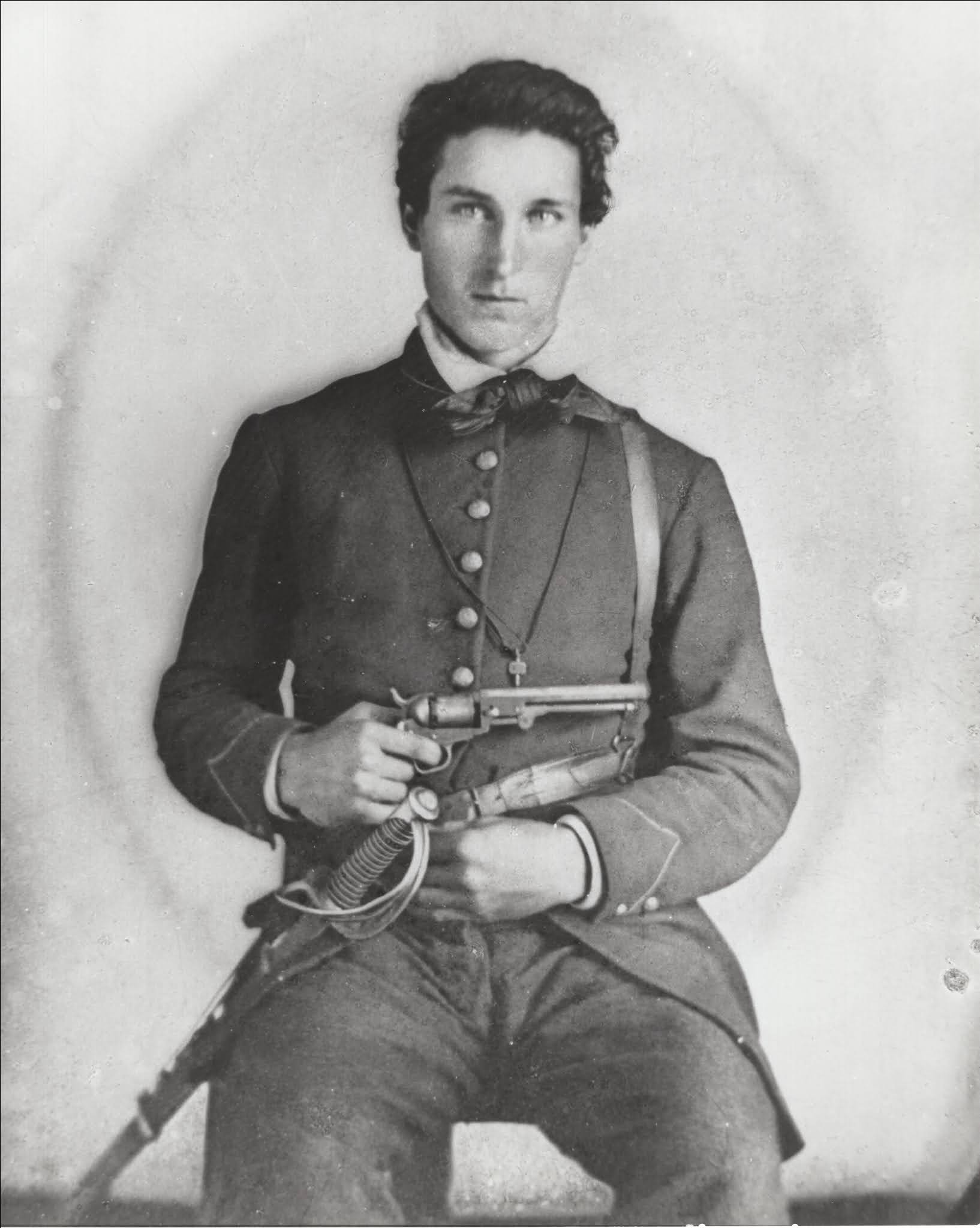
Imagine my surprise and excitement when I learned that transcriptions were published in someone else's book, with A. J. Lacy's photo on the cover!

A collection of Confederate diaries and letters

In 2006, Professor Howard Lytle Givens (who I believe is now deceased) published a collection of various letters and diaries of Confederate soldiers titled Tennesseans in the Civil War: Confederate Narratives from Battlefield and Home. While waiting for a copy of this book that my cousin Coby Lacy had sent me, I fantasized about discovering letters we'd never seen before. Or perhaps letters from other soldiers in Lieutenant Lacy's regiment that might shed light on the mystery of his disappearance.

But with the book finally in hand, my fantasies of learning something new about Lieutenant Lacy were dashed.

  1. Lieutenant Lacy's photo on the cover of the book is not a new one. It's actually a photo I had included when I had a website for Lacy many years ago.
  2. Chapter Eight includes Lacy's letters, with no annotation or discussion. Professor Givens reprinted the transcriptions of these letters, donated by my father to the Tennessee State Library & Archives, that are found on microfilm at TSLA. None of the other chapters include anything relevant to Lacy, his commanders, or his regiment.
  3. A short introductory paragraph for Chapter Eight mistakenly claims that Lieutenant Lacy served in Baxter Smith's Eighth Cavalry, instead of Dibrell's Eighth Cavalry. This mistake (one I've seen before) could have been avoided had the author done a little research.
  4. There is little to no evidence of any research on the part of the author except for some information gathered on the internet.
The Shawneetown letter - did Lieutenant Lacy survive the war as a Union officer?
(extracted from Battlefront and Homefront, copyright 2020 by Mark E. Lacy)

Lieutenant Lacy's only child, William Woolsey Lacy, was one of the first who tried to solve the mystery of his father's disappearance.

In the years since the end of the Civil War, W. W. Lacy, grew up, married, and had children of his own. But he must have entertained doubts that his father was a casualty of the war, and so he began asking questions.

We don't know how the two men got in touch with one another, but in the spring of 1893, thirty years after his father's disappearance during the war, W. W. Lacy received a letter from D. H. Jones of Medley, Missouri. This was not the first correspondence between the men. Jones had learned somehow of W. W. Lacy's search for his father, and passed along some information.

"... I think I made a mistake in the address of Mr. A. J. Lacy it is at Shoney Town Ills. I know thare is a man up thare by the name of A. J. Lacy for I am well acqanted with him. He marred a girl that was raised in the same neighborhood of my self. Her name is Miss Eison but she is dead now and he is a widower iff he has not marred sece last spring. He is a man of a bout 50 years of age 5-8 in hi lite complexion blue eyes and and was an officer in the Union Army and is from Tenn but I dont know what part."

No one knows that W. W. Lacy might have done with this information. But using modern tools and data unavailable to W. W. Lacy, it is clear that there are no records of a Union officer named A. J. Lacy in this timeframe (1890s) living in Illinois. Jones seemed to have confused A. J. Lacy with Royal R. Lacey, a former Union officer in the same area in southeast Illinois who had married a woman with the maiden name of Eison.

Final remarks

The mystery is still that: a mystery. A cold case to beat all cold cases. But I hold on to a hope that someday the right information will turn up to shed light on this mystery, if not to actually solve it.

Tuesday, May 25, 2021

Guest Blogger Sharyn McCrumb on the Roots of Appalachian Culture

A novel of a historian following the trail of
a young woman who escaped the Shawnee in 1799.
In my post of April 20, Deep Geographic Memory, Bagpipes, and Electronic Music, I mentioned New York Times bestselling author Sharyn McCrumb. It is my pleasure to share with you, courtesy of Sharyn, a piece that she wrote on the topic of how the early American settlers brought with them, as they journeyed west into the Appalachians, music and stories from England, Scotland, and Ireland. That culture, once transplanted, acquired small differences, but it reflected--and still reflects--the "old country", even as the Appalachians reflect the landscape of the hills and valleys that these settlers would've called their original home.

I thank Sharyn for giving me permission to reprint this! Please see her bio at the bottom of this post. You can learn more about her and her work at www.SharynMcCrumb.com and www.facebook.com/SharynMcCrumbAuthor.


Wayfaring Strangers

By Sharyn McCrumb 

from the 2017 Mountains of Music Magazine
for The Crooked Road, Virginia's Musical Heritage Trail

Copyright 2017 Sharyn McCrumb


My home’s across the Blue Ridge Mountains
And I never expect to see you anymore.

They must have felt that way once—more than a century before that song was written—when the settlers rolled down the Great Wagon Road that followed the valleys between the wall of mountains that stretched on forever. When the settlers reached the middle of Virginia—about where Roanoke is today—some of them headed west on the Wilderness Road, ending up on the 18th century frontier, in southwest Virginia, east Tennessee, eastern Kentucky, and western North Carolina.

They, or their recent forebears, had already made one perilous journey in a lifetime, across the Atlantic from Scotland or Ireland or England, to settle in the New World, but the eastern seaboard was already getting crowded by the late eighteenth century, mostly full of the people they left Britain to get away from. (Besides: you could see the neighbors.) So they ventured deeper into the mountains, looking for a place that felt like home. They never knew how close they were to being back home; nearly two more centuries would pass before geologists put together the ancient puzzle of earth’s Triassic period to discover that millions of years ago the Appalachians had been part of those same mountains in Britain from which many of the settlers themselves had come.

The new people brought what they could from home—not material things, because the ships were small, so you had to pack light—but they carried with them everything they could fit into their heads, because memories were all they had left of the places they’d come from, and they treasured them. They handed down these memories to their children and grandchildren, which is why in 1914 musicologist Cecil Sharpe found the traditional folksongs he was looking for, not in Britain where they had originated, but in the southern Appalachians, where they were cherished remnants of the past.

Things changed a bit in the new world. If you came over with an unusual name—Rhys (Welsh) or O’Laoghaire (Irish) or McDiarmuid (Scots)—sooner or later some census taker would standardize you to “Reese,” “O’Leary,” and “McDermott.” The songs and stories got naturalized, too. The Wexford Girl became The Knoxville Girl, and Lady Margaret of the Child Ballad was demoted to Little Margaret over here, but the plots of the songs stayed the same, and the tunes were still recognizable. When The Lily of the West was composed, back in Ireland, the “West” was the coast of Ireland: Galway or Connemara. Many years later when people sang the song in America, the “West” they pictured was Kentucky (“When first I came to Louisville, some pleasure there to find…”)

You never know when the family resemblance is going to peek out at you. Years ago, I took a newly-arrived Scottish professor to an Appalachian storytelling festival. The speaker began a tale about an old farmer who was fishing in a mountain stream and caught a big old trout. As the story wound on to the part where the farmer found a gold ring in the belly of the fish, the Scottish professor began to nudge me with his elbow. Finally when the story ended, I asked him what he had wanted so urgently to tell me. “Right,” he said. “About that story the fellow told. First of all, it wasn’t an old farmer; it was St. Mungo of Glasgow; and it wasn’t a mountain stream; it was the Firth of Clyde. And it wasn’t a trout; it was a salmon. – But the rest of the story is correct.”

They brought their fiddle tunes from Scotland, their knowledge of whisky-making from Ireland, and their quilt patterns from a time before history began. (The Hangman’s Beautiful Daughter.)  But just as English timothy hay became Kentucky bluegrass in the New World, sooner or later almost everything that the settlers brought with them got a North American spin. We were a long way from where we started, but if you look closely, you can see where we hailed from.


Sharyn McCrumb

Sharyn McCrumb, an award-winning Southern writer, is best known for her Appalachian “Ballad” novels, including the New York Times best sellers The Ballad of Tom Dooley, The Ballad of Frankie Silver, and The Songcatcher. Ghost Riders won the Wilma Dykeman Award for Literature from the East Tennessee Historical Society and the national Audie Award for Best Recorded Book..        
       Sharyn McCrumb, named a Virginia Woman of History by the Library of Virginia and a Woman of the Arts by the national Daughters of the American Revolution, was given a merit award for literature by the West Virginia Library Association (2017) and the Mary Hobson Prize for Arts & Letters (2014). Her books have been named New York Times and Los Angeles Times Notable Books, and have been translated into eleven languages.


Tuesday, March 16, 2021

A Little Girl and a Great Big Bomb

Once upon a time, two stern-looking military police knocked on the door of my grandparents' house. Their visit was ominous. They had questions about something my mother, age ten, had said on the school bus about blowing up her school.

In this day and age, comments of that kind would certainly be noticed and followed up on.

Now imagine that comment being made in 1944 at Oak Ridge, Tennessee, where research on the atomic bomb was taking place under strict secrecy.

Secret work

Mom had been miffed with one of her schoolteachers. Her comment on the school bus was only an offhand remark and an angry wish. But you don't talk about explosions if your father (my grandfather, Grady Webb) is working at a secret facility building the most powerful weapon the world had yet to see.

Grady, like everyone else he worked alongside, did not know the true purpose of the Oak Ridge facility. He was a millwright, tasked with keeping machinery working, even if he had no knowledge of the final product of all that machinery. Every morning, though, as he and the others entered the factory, guards would wave Geiger counters up and down each arm and leg, head and chest. Few of them knew what a Geiger counter was. If anyone's radiation exposure was too high, they were reassigned to another part of the facility.

Mom got off with a stern warning. In time, my grandparents would better understand why these officials came to their door. Grady discovered, on a tragic day in early August 1945, the role Oak Ridge had played in bringing an end to World War II. He was not a government employee but instead worked for one of the contractors responsible for maintaining the facility, Carbide & Carbon Chemical Corporation (later known as Union Carbide). After the war he was presented with a certificate for contributing to the Manhattan Project.

Recognition for contributing to the end of World War II

"United States of America, War Department, Army Service Forces - Corps of Engineers, Manhattan District -

"This is to certify that Grady W. Webb, Carbide & Carbon Chemicals Corp., has participated in work essential to the production of the Atomic Bomb, thereby contributing to the successful conclusion of World War II. This certificate is awarded in appreciation of effective service."

The certificate was signed by Henry L. Stimson, the Secretary of War, and dated 6 August 1945, the day the first atomic bomb was dropped on Japan, at Hiroshima.

There are important ethical questions regarding the use of nuclear weapons against Japan in World War II. Was this use of the atomic bomb necessary, or was it avoidable? I am not a scholar of World War II history, so I can't really take a side. But it does cause some real cognitive dissonance. I am proud of my grandfather for his contribution to the end of a terrible war, and at the same time, I lament that this contribution and the work of thousands of other people led to the deaths of tens of thousands of Japanese civilians.

Comic relief

I hope you can forgive me for ending this post on a lighter note: I'm grateful my mother was not jailed for "subversive" childhood comments. And that her most serious offense over her long life was nothing worse than backing out of her driveway into a parked police car. ("But he shouldn't have parked there!")