Showing posts with label Civil War. Show all posts

Tuesday, August 10, 2021

"April 1865: The Month That Saved America"

Most people know that Lincoln was assassinated in April 1865, and that Lee surrendered to Grant at Appomattox that same month. It was the beginning of the end of the Civil War.

What most people don't know (but I learned from Jay Winik's excellent book, April 1865: The Month That Saved America) is that the military and political leadership of both the Union and the Confederacy were involved in momentous decisions in April that helped bring the war to an end, and bring the country back together. These were decisions that, had they been made differently, could've resulted in catastrophe for our nation. Even if the Union had won the war, and the South readmitted, our identity as a unified country might have been in jeopardy had these decisions been made differently. 

As Winik points out, using contemporary examples, some countries and regions never fully recover from civil wars. To increase the probability of long-lasting peace, Lincoln and Grant chose to disregard the railings of those who would bring shame and severe punishment on the heads of their conquered enemy. Though Jefferson Davis was all for a last-ditch attempt at preserving the Confederacy by sending the army into the hills for prolonged guerrilla warfare, Lee chose the high road, knowing the impact of a sustained war would only make matters far worse than they already were. Winik covers both the strengths and faults of Lincoln, Grant, Lee, Sherman, Johnson, Davis, and Forrest, and shows that, despite these faults, they made the decisions at the end of the war that enabled the U.S. to come back together.

The only thing I wish Winik had not omitted was a discussion of Lincoln's presidential pardons for high-ranking Confederate officers and officials, and how that played out with Andrew Johnson once he assumed the presidency. I believe Lincoln's policies in this regard played an important role in achieving peace, and Johnson's policies almost aborted this.

For a different but equally engaging account of events in April and May 1865, I highly recommend James L. Swanson's Bloody Crimes: The Chase for Jefferson Davis and the Death Pageant for Lincoln's Corpse.

Tuesday, July 27, 2021

Four Ministers and a Confederate Colonel

In a recent post I explained how network science shows that any two arbitrary people in the world may be more closely linked, through a chain of social connections, than one might expect. In exploring the history of my great-great-grandfather Second Lt. Andrew Jackson Lacy's service in Tennessee's Confederate cavalry, I discovered a chain of associations among army chaplains, ministers, and the commander of Lieutenant Lacy's regiment.

The Needs of Body and Soul

In a letter he wrote a month after joining Tennessee's Confederate cavalry, Lieutenant Lacy spoke of going to church and hearing "Dr. Pendergrass" preach. The chaplain of Lacy's regiment, the Eighth Tennessee Cavalry, was Charles Wylie Witt, a minister of the Cumberland Presbyterian Church. "Parson" Witt's nephew, Travis Witt Pendergrass, actually accompanied this regiment for several months, attending to the needs of both body (surgery) and soul (exhortation). Like his uncle, Pendergrass was a minister of the Cumberland Presbyterian church. His three younger brothers were all in the same company as Lieutenant Lacy. (1)

Reconnected in the Middle of War

A few months after Lieutenant Lacy heard Pendergrass preach, the Eighth Cavalry was sent to Florence, Alabama.  There Pendergrass was surprised to run into a fellow Cumberland Presbyterian minister, Thomas Fletcher Bates.  Then, to his further surprise, he encountered Rev. R. A. Young, a prominent preacher in the Methodist Episcopal Church, South, currently serving as president of the Wesleyan University in Florence.  Pendergrass had met Young in Lebanon, Tennessee in 1853, shortly before Young was reassigned to a pastorate in St. Louis, Missouri. (2)

A Confederate Colonel

In 1846, Reverend Young had met the "plain, quiet" son of his friend, Anthony Dibrell. That son, George Gibbs Dibrell, was now a colonel commanding the Eighth Tennessee Cavalry. Of Colonel Dibrell's religious convictions, Young said "When his [Dibrell's] chaplain preached to his command, standing between two tallow candles, one of his most devout listeners was the commander in chief."  The chaplain he refers to is most likely Charles Witt. (3)

And the Lacy Family Is Indebted to Chaplain Charles Witt

Before Lieutenant Lacy's regiment returned to Tennessee from Alabama, Charles Witt resigned as chaplain, complaining that the varicose veins in his legs made riding a horse very uncomfortable. Pendergrass signed off on a medical discharge for his uncle. When Witt left Florence for Jackson County, Tennessee, he delivered to Lacy's family an accounting that Lieutenant Lacy had kept of all the operations of the Eighth Cavalry up to that point. The family owns that document today. (4)


(1) Lacy, Mark E. MISSING IN ACTION, 1863: Lieutenant Andrew Jackson Lacy and Tennessee's Confederate Cavalry. 2019.

(2)Pendergrass, T. W. to Nancy Pendergrass, 15 March 1863. http://freepages.genealogy.rootsweb.ancestry.com/~pendergrass/pics/travis/pics_travis.html 

(3) Young, R. A. Reminiscences. Nashville, Tennessee: Publishing House Methodist Episcopal Church, South, 1900. https://readux.library.emory.edu/books/emory%3A7sv2p/pdf/

(4) Lacy, Mark E. Battlefront and Homefront: The Lacy Family's Civil War Documents. 2020.

Tuesday, July 6, 2021

Defoliation in War, Herbicides in Peace

The Bombing of Vietnam

In 1968, our eighth grade Civics teacher, Mr. Henry, assigned debate topics to our class. Our group of four included two teams of two students each to debate whether the U.S. should pull out of Vietnam. My partner and I were to take the position that the U.S. should pull out. 

Everyone in the class had to research their topics in the school library. I quickly learned the relative liberal/conservative stances of the major news magazines. TIME Magazine seemed biased toward withdrawal. U.S. News and World Report leaned toward staying in the war. Newsweek seemed to take a more neutral stance. The only statistic I can now remember having dug up to support our position on withdrawing from the war was this: that one ton of bombs had been dropped by the U.S. for every man, woman, and child living in Vietnam. (Fifty-three years later, I'm unable to verify this statistic. But according to this article, the same statistic held for the bombing of Laos between 1964 and 1973.) 

A few years later I learned there was something more insidious taking place in the natural world of Southeast Asia. It was something that didn't leave craters in the jungle floor. It was something that didn't strike with the sudden flare of a stream of napalm laid down across a verdant jungle. 

Defoliation in Vietnam, and Sherman's "March to the Sea"

Even as the first Earth Day was being celebrated in April 1970, American forces were executing a scorched-earth policy in Vietnam, a policy with echoes of Sherman's destruction of the South during the Civil War.* Bombs and napalm were only one part of waging war in Southeast Asia. Defoliants were dropped from planes, withering every living crop, plant, or tree they touched. These herbicides were sprayed on rice paddies and other agricultural areas to deprive the Viet Cong of food, just as Union troops burned fields and crops as a means of depriving Confederate forces (both regulars and guerrillas) and their supporters of food and livestock. Defoliants were also sprayed over jungle areas with the hope that stripping the foliage would reduce the number of hiding places for the Viet Cong.** 

Agent Orange was the defoliant used in Vietnam. It contained two compounds (2,4-D and 2,4,5-T) that mimic plant hormones, and tetrachlorodioxin, and a contaminant caused by the synthesis of 2,4,5-T. Dioxin is known for being highly teratogenic (developmentally toxic, causing birth defects), much more so than the infamous morning-sickness drug, thalidomide. Sadly, a large number of citizens in Southeast Asia were born with birth defects subsequent to the defoliation campaigns during the Vietnam War. For this reason, Agent Orange is no longer used and 2,4,5-T has been banned as an herbicide since 1985.

Peaceful uses of herbicides

In the years since the Vietnam War, herbicides based on the compound glyphosate have become the world's most widely used herbicides. Glyphosate's major use is in agriculture, where it is sprayed on crops that are genetically modified to resist glyphosate, inhibiting the growth of weeds among the crops. As one would expect, because of the extensive use of glyphosate, a great deal of attention has been focused on safety concerns. Regulatory agencies around the world, as well as organizations within the United Nations, have examined data regarding glyphosate's effects on not only human health but the environment as well. Unfortunately, while glyphosate is considered safe in many instances, there is a great deal of controversy. This may be due to the huge number of different formulations of glyphosate-based herbicides. Some studies have suggested particular components in herbicide formulations -- other than the glyphosate itself -- may be significantly less safe than glyphosate.

If you want to kill a plant, one way is to inhibit, as glyphosate does, an enzyme that plants depend on for growth (and animals do not have). That is an example of an intervention in a botanical system. As the development of herbicide resistance is more frequently seen, intervening in two places in a botanical system could be a more powerful way to kill plants. The likelihood of plants circumventing two interventions through development of resistance is very small. This is the rationale behind new herbicides that use both glyphosate and 2,4-D in their formulations.

Not surprisingly, the companies that market glyphosate-based herbicides also market seeds for crops that have been genetically modified to resist glyphosate.

Many government agencies have looked at, and continue to look at, questions of toxicity for glyphosate. We can only hope that as time goes on, we will have more answers than questions.

Tuesday, June 15, 2021

Tackling a Mystery Almost One Hundred Sixty Years Old

The disappearance of Lt. Andrew Jackson Lacy

As I have detailed in my book, MISSING IN ACTION, 1863: Lieutenant Andrew Jackson Lacy and Tennessee's Confederate Cavalry, my great-great-grandfather disappeared in the middle of the Civil War and was never seen again. He disappeared after resigning his officer's commission. The most likely explanation for his disappearance is that he was bushwhacked by the enemy on his way home in Jackson County, Tennessee. The evidence strongly suggests this took place sometime in the beginning of August 1863, within twenty-five miles of home.

The companion volume to MISSING IN ACTION, 1863, titled Battlefront and Homefront: The Lacy Family's Civil War Documents, includes annotated transcriptions of all the family letters, to and from Lieutenant Lacy, during the Civil War.

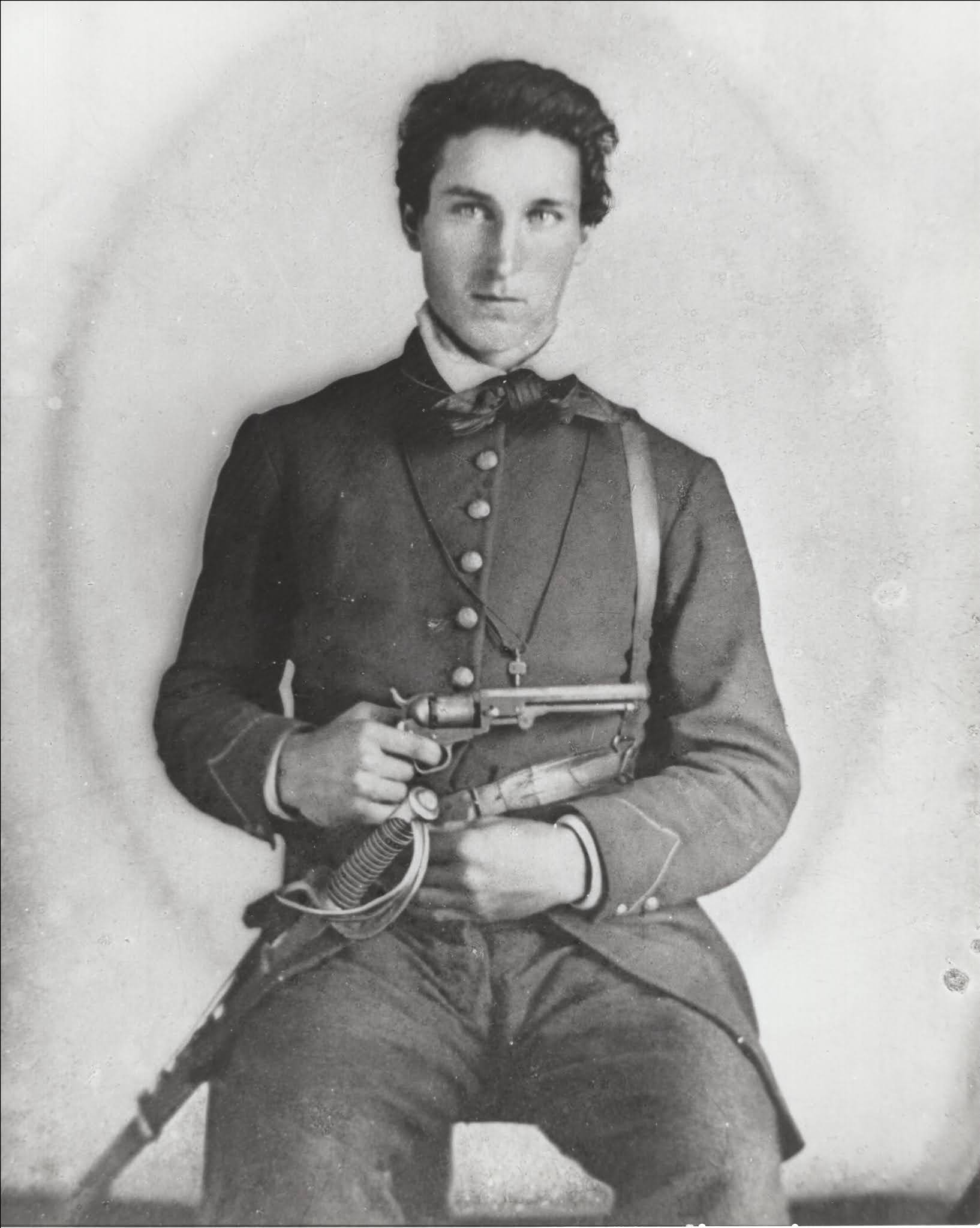
Imagine my surprise and excitement when I learned that transcriptions were published in someone else's book, with A. J. Lacy's photo on the cover!

A collection of Confederate diaries and letters

In 2006, Professor Howard Lytle Givens (who I believe is now deceased) published a collection of various letters and diaries of Confederate soldiers titled Tennesseans in the Civil War: Confederate Narratives from Battlefield and Home. While waiting for a copy of this book that my cousin Coby Lacy had sent me, I fantasized about discovering letters we'd never seen before. Or perhaps letters from other soldiers in Lieutenant Lacy's regiment that might shed light on the mystery of his disappearance.

But with the book finally in hand, my fantasies of learning something new about Lieutenant Lacy were dashed.

  1. Lieutenant Lacy's photo on the cover of the book is not a new one. It's actually a photo I had included when I had a website for Lacy many years ago.
  2. Chapter Eight includes Lacy's letters, with no annotation or discussion. Professor Givens reprinted the transcriptions of these letters, donated by my father to the Tennessee State Library & Archives, that are found on microfilm at TSLA. None of the other chapters include anything relevant to Lacy, his commanders, or his regiment.
  3. A short introductory paragraph for Chapter Eight mistakenly claims that Lieutenant Lacy served in Baxter Smith's Eighth Cavalry, instead of Dibrell's Eighth Cavalry. This mistake (one I've seen before) could have been avoided had the author done a little research.
  4. There is little to no evidence of any research on the part of the author except for some information gathered on the internet.
The Shawneetown letter - did Lieutenant Lacy survive the war as a Union officer?
(extracted from Battlefront and Homefront, copyright 2020 by Mark E. Lacy)

Lieutenant Lacy's only child, William Woolsey Lacy, was one of the first who tried to solve the mystery of his father's disappearance.

In the years since the end of the Civil War, W. W. Lacy, grew up, married, and had children of his own. But he must have entertained doubts that his father was a casualty of the war, and so he began asking questions.

We don't know how the two men got in touch with one another, but in the spring of 1893, thirty years after his father's disappearance during the war, W. W. Lacy received a letter from D. H. Jones of Medley, Missouri. This was not the first correspondence between the men. Jones had learned somehow of W. W. Lacy's search for his father, and passed along some information.

"... I think I made a mistake in the address of Mr. A. J. Lacy it is at Shoney Town Ills. I know thare is a man up thare by the name of A. J. Lacy for I am well acqanted with him. He marred a girl that was raised in the same neighborhood of my self. Her name is Miss Eison but she is dead now and he is a widower iff he has not marred sece last spring. He is a man of a bout 50 years of age 5-8 in hi lite complexion blue eyes and and was an officer in the Union Army and is from Tenn but I dont know what part."

No one knows that W. W. Lacy might have done with this information. But using modern tools and data unavailable to W. W. Lacy, it is clear that there are no records of a Union officer named A. J. Lacy in this timeframe (1890s) living in Illinois. Jones seemed to have confused A. J. Lacy with Royal R. Lacey, a former Union officer in the same area in southeast Illinois who had married a woman with the maiden name of Eison.

Final remarks

The mystery is still that: a mystery. A cold case to beat all cold cases. But I hold on to a hope that someday the right information will turn up to shed light on this mystery, if not to actually solve it.

Tuesday, May 4, 2021

Ensuring the Survival of Life's Details

Second Lt. Andrew Jackson Lacy,
Eighth Tennessee Cavalry (CSA), 1862


My family is fortunate and privileged to have a massive amount of photographs, correspondence, and recordings that detail the history of our family, going back to before the Civil War. This information includes:
  • deeds from the 1850s to the early 1900s
  • dozens of letters written during the Civil War (see my book, Battlefront and Homefront: The Lacy Family's Civil War Documents)
  • over 800 letters written since 1879 (though in recent times the family basically quit writing letters because of email)
  • over 1000 photographs (and color slides) from 1862 to the advent of digital photography
  • extracts of my father's diaries from 1969 to 1981
  • all the articles and newspaper columns my father wrote
  • over 200 cassette recordings ("letters") between my family and my grandparents from 1972 to 1988
  • cassette recordings of interviews of family members (including both toddlers and elders)
  • informal memoirs by several family members
  • VHS tapes of special occasions
The problem is preserving this information. Documents can burn. Photographs fade. Tape recordings deteriorate. Entropy is the enemy.

Digitizing and sharing

I have digitized (scanned, ripped) and/or transcribed all of this information. In some cases I've had to physically disassemble photo albums and scrapbooks in order to scan the material. In the case of color slides and recordings on tape, the original media has been thrown away because it was deteriorating, and it becomes more difficult with each passing year to find equipment that the original media will play on. 

This information has been preserved, but the main task now is to remove duplicates and curate all that information (label it, date it, arrange it chronologically). Even though my parents always admonished us to label photos with dates and names of who was in the photos, well-annotated photos over the broad timescale we're talking about are the exception rather than the rule. In many cases the only way to determine chronology is to study the details (like a baby's outfit), tap the details in our family tree (like when a couple got married, or when a person died), or cross-reference a photo using information from a letter.

A concurrent challenge is that of finding the best way to share all this information. Most online systems I've found don't meet my criteria for ease of use, free or low cost, broad applicability, or facilitating the kind of annotation that is needed. Anyone I share this information with probably can open an Excel spreadsheet, a Word document, a JPG image file, or an audio file. I set up a method for labeling each file and listing those files, with dates or approximate dates, peoples' names, and other information, in an Excel workbook. All the files are organized in folders arranged by information type (letters, photos, other documents).

What good is it?

Yes, I'm crazy to take all this on, but I can't bear the thought of this information being lost, unavailable to future generations. There is enough material at-hand that a family historian could piece together a very detailed chronicle of the lives of my family's members from the time the family settled in the Upper Cumberland region of Middle Tennessee around 1850 to today.

Posterity is the word. Immortality is a pipe-dream, but no one will every have this information if it's not conserved.

For further reading