Tuesday, July 6, 2021

Defoliation in War, Herbicides in Peace

The Bombing of Vietnam

In 1968, our eighth grade Civics teacher, Mr. Henry, assigned debate topics to our class. Our group of four included two teams of two students each to debate whether the U.S. should pull out of Vietnam. My partner and I were to take the position that the U.S. should pull out. 

Everyone in the class had to research their topics in the school library. I quickly learned the relative liberal/conservative stances of the major news magazines. TIME Magazine seemed biased toward withdrawal. U.S. News and World Report leaned toward staying in the war. Newsweek seemed to take a more neutral stance. The only statistic I can now remember having dug up to support our position on withdrawing from the war was this: that one ton of bombs had been dropped by the U.S. for every man, woman, and child living in Vietnam. (Fifty-three years later, I'm unable to verify this statistic. But according to this article, the same statistic held for the bombing of Laos between 1964 and 1973.) 

A few years later I learned there was something more insidious taking place in the natural world of Southeast Asia. It was something that didn't leave craters in the jungle floor. It was something that didn't strike with the sudden flare of a stream of napalm laid down across a verdant jungle. 

Defoliation in Vietnam, and Sherman's "March to the Sea"

Even as the first Earth Day was being celebrated in April 1970, American forces were executing a scorched-earth policy in Vietnam, a policy with echoes of Sherman's destruction of the South during the Civil War.* Bombs and napalm were only one part of waging war in Southeast Asia. Defoliants were dropped from planes, withering every living crop, plant, or tree they touched. These herbicides were sprayed on rice paddies and other agricultural areas to deprive the Viet Cong of food, just as Union troops burned fields and crops as a means of depriving Confederate forces (both regulars and guerrillas) and their supporters of food and livestock. Defoliants were also sprayed over jungle areas with the hope that stripping the foliage would reduce the number of hiding places for the Viet Cong.** 

Agent Orange was the defoliant used in Vietnam. It contained two compounds (2,4-D and 2,4,5-T) that mimic plant hormones, and tetrachlorodioxin, and a contaminant caused by the synthesis of 2,4,5-T. Dioxin is known for being highly teratogenic (developmentally toxic, causing birth defects), much more so than the infamous morning-sickness drug, thalidomide. Sadly, a large number of citizens in Southeast Asia were born with birth defects subsequent to the defoliation campaigns during the Vietnam War. For this reason, Agent Orange is no longer used and 2,4,5-T has been banned as an herbicide since 1985.

Peaceful uses of herbicides

In the years since the Vietnam War, herbicides based on the compound glyphosate have become the world's most widely used herbicides. Glyphosate's major use is in agriculture, where it is sprayed on crops that are genetically modified to resist glyphosate, inhibiting the growth of weeds among the crops. As one would expect, because of the extensive use of glyphosate, a great deal of attention has been focused on safety concerns. Regulatory agencies around the world, as well as organizations within the United Nations, have examined data regarding glyphosate's effects on not only human health but the environment as well. Unfortunately, while glyphosate is considered safe in many instances, there is a great deal of controversy. This may be due to the huge number of different formulations of glyphosate-based herbicides. Some studies have suggested particular components in herbicide formulations -- other than the glyphosate itself -- may be significantly less safe than glyphosate.

If you want to kill a plant, one way is to inhibit, as glyphosate does, an enzyme that plants depend on for growth (and animals do not have). That is an example of an intervention in a botanical system. As the development of herbicide resistance is more frequently seen, intervening in two places in a botanical system could be a more powerful way to kill plants. The likelihood of plants circumventing two interventions through development of resistance is very small. This is the rationale behind new herbicides that use both glyphosate and 2,4-D in their formulations.

Not surprisingly, the companies that market glyphosate-based herbicides also market seeds for crops that have been genetically modified to resist glyphosate.

Many government agencies have looked at, and continue to look at, questions of toxicity for glyphosate. We can only hope that as time goes on, we will have more answers than questions.

Tuesday, June 29, 2021

Celtic Rock, Appalachian Stories, and Knowledge Maps

Six Degrees of Separation

Most people know of the "six degrees of separation" concept because of the popularity of the "six degrees of Kevin Bacon" game. On average, any two actors in the world can be connected through a chain of movies in which actors have co-starred. 

More broadly, network science tells us that any two people in the world can be connected through social connections by no more than six jumps. Here are a few examples of my own:

  1. I am one degree from the deceased actor Vincent Price -- I once shook his hand at a college event. Anyone he knows, or starred in a movie with, is only two degrees from me. (Admittedly the social connection was not a remarkable one. LOL)
  2. I have met two Nobel Prize winners, which places me one degree away from each of them, and two degrees from the King of Sweden, who hands the prizes to each winner. 
  3. I have a relative who was a campaign manager for Senator Bob Dole years ago, which places me two steps from Dole and three steps from everyone Dole knew in Congress and Washington, DC. 
  4. Thanks to my father, who got Project Mercury astronaut Wally Schirra's autograph in 1964, I am three degrees from just about everyone in NASA's early space program. 
  5. Sadly, I am one degree from at least three people who took their own lives, and only two degrees from a political assassination in Venezuela.
Connections

Six degrees of separation is a social phenomenon. Work at digging up who is connected to whom, and you can wind up with a huge network of connections. Then, you can follow the network from one point to the next and uncover connections you didn't know about.

But what about other networks? A clever programmer could "scrape" (as they call it) book recommendations from Amazon's website and come up with a map of related books that might show you recommendations that were two or three or four steps away from a book you're looking at, instead of only one step away.

Still, these examples are only focused on connections between the same kinds of things (people with people, books with books). There's no a priori reason why we can't derive a network connecting different kinds of things that are related. A more sophisticated example using Amazon recommendations would include authors as well as books. Each author could be connected to every book that author has written, books could be connected to co-authors, and authors within a certain genre could all be connected. This would be useful if you wanted to use authors for recommendations, and not just books.

Discovery and knowledge

To take this one step further, consider an example network I created that connects certain authors, books, musicians, genres, and influences on musicians. The example network, shown at the bottom of this post, is something I developed using the yEd and yEd Live network drawing software, both of which are free software products from the software company yWorks. (An interactive version of this network, which includes hyperlinks, can be accessed via this link.)

At the top of the diagram are three authors, including J. R. R. Tolkien, Alex Bledsoe, and Sharyn McCrumb. (For more on Sharyn McCrumb, see this recent post of mine.) Beneath each author is an icon showing something that author has written. The Lord of the Rings is fantasy, of course, as are Bledsoe's "Tufa" stories, set in a modern-day part of the mountains of Tennessee. Many of Sharyn McCrumb's novels are set in the Appalachians.

Below that part of the diagram is the musician Dave Brons. Brons, who composes and performs progressive rock with a "Celtic symphonic twist", found inspiration in The Lord of the Rings. Bledsoe's "Tufa" novels inspired a group of musicians known as Tuatha Dea, also shown on the diagram, who compose and perform what they call "Appalachian Rock." Both Brons and Tuatha Dea have been influenced by Celtic culture. (And, Tuatha Dea has also been influenced by "steampunk.")

Final Remarks

The diagram I created is a small example of a knowledge map. It captures a set of connections I thought were interesting, that I can share with others, and that may lead others to consider artists or authors or works they might not realize were connected. As a knowledge map, it can be extended to include as many connections as I would like.


Knowledge map created using the free tools, yEd and yEd Live. See text for link.
Copyright Mark E. Lacy, 2021
.


Tuesday, June 22, 2021

Bugs Bunny: Teacher and Mentor

Exposure to a Mischievous Cartoon Rabbit at an Impressionable Age

My wife likes to remind me to turn off the lights in a room when I leave it. So when I turned off our kitchen lights this evening, I said "Click!"

I didn't think about it, when I said "Click!", but I was alluding to a trick with a light switch Bugs Bunny plays on the Big Bad Wolf in the cartoon titled, "The Windblown Hare." Because I watched Bugs Bunny religiously during my formative years, it's not unusual for me to repeat something I learned so long ago from a cartoon.

From 1940 to 1964, Warner Bros. produced 170 cartoons featuring this iconic cartoon character. I grew up watching Bugs Bunny cartoons as well as many others produced under the Looney Tunes and Merrie Melodies labels. Thursday nights, when I was little, we watched "The Bugs Bunny Show." My father enjoyed watching Bugs almost as much as watching the Pink Panther. When Bugs moved to Saturday mornings, it was the centerpiece and main course of all the morning cartoons.

Bugs is a culturally-recognized example of the "trickster" archetype. On one hand, he's a friendly character who doesn't go looking for trouble. But on the other hand, once someone brings trouble to him, they better watch out! He is quite adept at devising clever tricks to play on those who have wronged him.

Time to Get Serious, and Make a List

Several years ago, I decided to apply my inherited and inordinate fondness for making lists by constructing a list of all the Bugs Bunny cartoons, drawing on information from Looney Tunes and Merrie Melodies: A Complete Illustrated Guide to the Warner Bros. Cartoons by Jerry Beck and Will Friedwald. One by one, I checked off the ones I had watched. When I needed a few more to watch to complete the list, I found them on YouTube.

Going back to watching many of the old cartoons was spurred in part by a trend that concerned me. Many of the old Warner Bros. cartoons, including Bugs Bunny, were being censored before being shown on Cartoon Network. A shotgun blast to a character's face would be deleted, for example. I surmised that some group of concerned parents were influencing network executives to edit the cartoons for anything that might -- as these parents believed -- have a negative influence on their children's behavior. As I looked into this, I found there were entire cartoons featuring Bugs Bunny that have been banned because they depicted not just violence but racial stereotypes. These cartoons are not shown on TV but can be found on some DVDs or on YouTube. The DVDs released as the "Looney Tunes Golden Collection" are compilations that include, among many of most famous cartoons, some of the more controversial ones. Each DVD begins with a message explaining that while some cartoons on the disk depict unacceptable behaviors such as racial stereotypes, they are included for historical reasons. But then, cartoons such as "Bugs Bunny Nips the Nips," a World War II-era feature, can now only be found on YouTube. At the time this short originally came out, its treatment of the Japanese as our enemies was dehumanizing, an almost universal sociological factor in wartime. (This cartoon, as well as many others released in wartime, were intended as entertainment for adults, not children.)

What Bugs Bunny Has Taught Me

So what have I learned by watching cartoons like Bugs Bunny over the years? I've learned it's good to have sense of humor and not take oneself too seriously. I've learned that being clever is better than being out-and-out mean. I picked up various expressions (like Yosemite Sam's "Ya' durn idgit" and "Whoa, mule [camel, elephant], I said whoa!"), some of which have become so embodied in my day-to-day conversations that I often don't realize I'm quoting a cartoon character. (As when I say "click" when I turn off a light.) 

Other fans of Bugs have been educated in other ways. One person commented on Twitter that Bugs had taught him that "revenge on my enemies should be quick, clever, and brutal.")

What did I not learn? I did not learn that shooting someone in the face simply turns their face black with gunpowder. Nor did I learn to think in racist terms. And enjoying the antics of an anthropomorphized rabbit who some have labeled a "cross-dresser" has not harmed me.

Like many others, I miss the "golden years" of animated shorts.

Tuesday, June 15, 2021

Tackling a Mystery Almost One Hundred Sixty Years Old

The disappearance of Lt. Andrew Jackson Lacy

As I have detailed in my book, MISSING IN ACTION, 1863: Lieutenant Andrew Jackson Lacy and Tennessee's Confederate Cavalry, my great-great-grandfather disappeared in the middle of the Civil War and was never seen again. He disappeared after resigning his officer's commission. The most likely explanation for his disappearance is that he was bushwhacked by the enemy on his way home in Jackson County, Tennessee. The evidence strongly suggests this took place sometime in the beginning of August 1863, within twenty-five miles of home.

The companion volume to MISSING IN ACTION, 1863, titled Battlefront and Homefront: The Lacy Family's Civil War Documents, includes annotated transcriptions of all the family letters, to and from Lieutenant Lacy, during the Civil War.

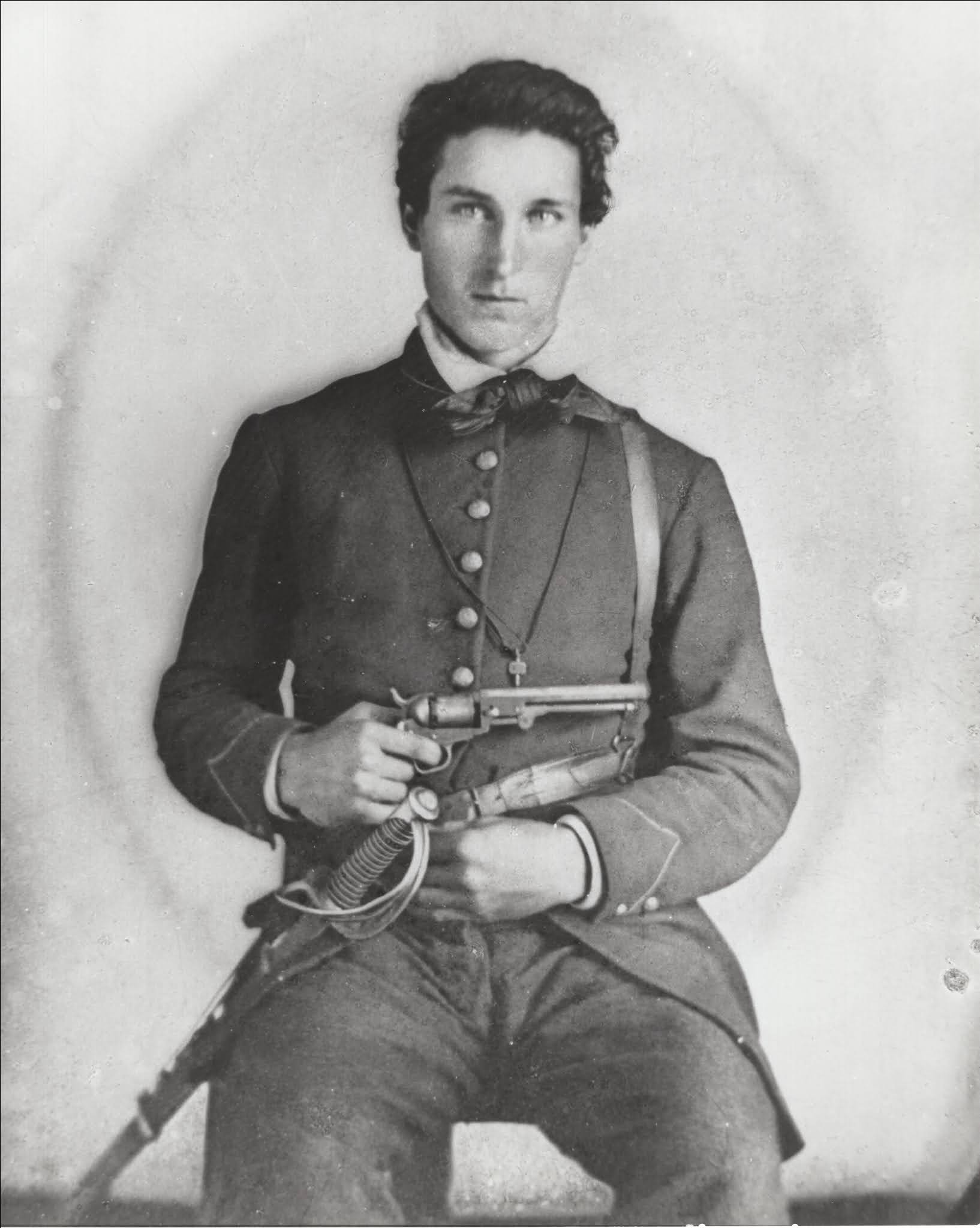
Imagine my surprise and excitement when I learned that transcriptions were published in someone else's book, with A. J. Lacy's photo on the cover!

A collection of Confederate diaries and letters

In 2006, Professor Howard Lytle Givens (who I believe is now deceased) published a collection of various letters and diaries of Confederate soldiers titled Tennesseans in the Civil War: Confederate Narratives from Battlefield and Home. While waiting for a copy of this book that my cousin Coby Lacy had sent me, I fantasized about discovering letters we'd never seen before. Or perhaps letters from other soldiers in Lieutenant Lacy's regiment that might shed light on the mystery of his disappearance.

But with the book finally in hand, my fantasies of learning something new about Lieutenant Lacy were dashed.

  1. Lieutenant Lacy's photo on the cover of the book is not a new one. It's actually a photo I had included when I had a website for Lacy many years ago.
  2. Chapter Eight includes Lacy's letters, with no annotation or discussion. Professor Givens reprinted the transcriptions of these letters, donated by my father to the Tennessee State Library & Archives, that are found on microfilm at TSLA. None of the other chapters include anything relevant to Lacy, his commanders, or his regiment.
  3. A short introductory paragraph for Chapter Eight mistakenly claims that Lieutenant Lacy served in Baxter Smith's Eighth Cavalry, instead of Dibrell's Eighth Cavalry. This mistake (one I've seen before) could have been avoided had the author done a little research.
  4. There is little to no evidence of any research on the part of the author except for some information gathered on the internet.
The Shawneetown letter - did Lieutenant Lacy survive the war as a Union officer?
(extracted from Battlefront and Homefront, copyright 2020 by Mark E. Lacy)

Lieutenant Lacy's only child, William Woolsey Lacy, was one of the first who tried to solve the mystery of his father's disappearance.

In the years since the end of the Civil War, W. W. Lacy, grew up, married, and had children of his own. But he must have entertained doubts that his father was a casualty of the war, and so he began asking questions.

We don't know how the two men got in touch with one another, but in the spring of 1893, thirty years after his father's disappearance during the war, W. W. Lacy received a letter from D. H. Jones of Medley, Missouri. This was not the first correspondence between the men. Jones had learned somehow of W. W. Lacy's search for his father, and passed along some information.

"... I think I made a mistake in the address of Mr. A. J. Lacy it is at Shoney Town Ills. I know thare is a man up thare by the name of A. J. Lacy for I am well acqanted with him. He marred a girl that was raised in the same neighborhood of my self. Her name is Miss Eison but she is dead now and he is a widower iff he has not marred sece last spring. He is a man of a bout 50 years of age 5-8 in hi lite complexion blue eyes and and was an officer in the Union Army and is from Tenn but I dont know what part."

No one knows that W. W. Lacy might have done with this information. But using modern tools and data unavailable to W. W. Lacy, it is clear that there are no records of a Union officer named A. J. Lacy in this timeframe (1890s) living in Illinois. Jones seemed to have confused A. J. Lacy with Royal R. Lacey, a former Union officer in the same area in southeast Illinois who had married a woman with the maiden name of Eison.

Final remarks

The mystery is still that: a mystery. A cold case to beat all cold cases. But I hold on to a hope that someday the right information will turn up to shed light on this mystery, if not to actually solve it.

Tuesday, June 8, 2021

Productivity Tools: Evernote vs OneNote - Both/And, not Either/Or

In virtually any kind of environment where people have a choice in what computer hardware or software they use, they will divide into camps. PC vs Mac. Microsoft Office vs OpenOffice. Google Chrome vs Bing. Personal productivity is indeed that: personal. Two of the most popular productivity tools on the market are Evernote and Microsoft OneNote. I have chosen, after years of using both tools, to claim dual citizenship in their respective camps: I use both tools.

OneNote

When Microsoft first introduced OneNote, I was immediately sold on the notion of having a place on my computer where I could save notes, documents, photos, files, and more, organized in a convenient fashion and easily accessible. OneNote allowed me to mix note types, organize them in a way I could quickly get to them, and begin eliminating paper files. For several years I was a OneNote zealot. It cost me nothing, since I had a corporate license, and later it was part of Office 365 so I didn't have to pay for it separately.

But one thing I found, over time, was that I needed to access my notes across multiple platforms: web, laptop, tablet, phone, etc. While Microsoft has since made progress in making OneNote less platform-dependent, I was anxious to find a tool I could use anywhere, under any circumstances.

Evernote

Evernote was the solution I needed. When it was first released I gave it a try and found it to be much more in line with my work habits than OneNote. But when I learned that, in order to take full advantage of the tool I would have to pay a yearly subscription fee, I decided to stick with OneNote. Eventually, using the free version of Evernote, I realized paying a yearly subscription fee for Evernote was well worth it, and I moved to using only Evernote.

Evernote vs OneNote

OneNote and Evernote each have their advantages and disadvantages. Some of these include:

  • Attachments. I like how Evernote handles attachments better than how OneNote does. 
  • Responsiveness. OneNote feels "snappier" and much more responsive (as long as I have syncing with OneDrive turned off, because that seems to slow things down).
  • Embedded links. In Evernote you can embed links to other notes. OneNote goes one better and allows the user to embed links to particular paragraphs in other notes.
  • Tagging. In my experience, tagging in Evernote is hands-down better than in OneNote. But then tags aren't that important for me in my writing. 
  • Hierarchy of notes. A deeper hierarchy of note organization with OneNote is a beneficial trade-off. (Neither product allows for an unlimited hierarchy of notes, for some reason.)

But what if I could get the best of both worlds somehow?

OneNote AND Evernote

Evernote, over the past year, has harmonized the user experience across multiple platforms. It has not, for many people, been a comfortable experience moving to the latest version. Whatever their software management strategy might be, Evernote is listening better to its user base and is turning out improved versions and updates at a much more rapid pace.

Because of the negative user experience during this transition, many Evernote users have switched to other platforms, like OneNote. I considered this possibility myself, since I had experience with both platforms. But the process of porting 13,000 notes (no, that's not a typo) from Evernote to OneNote would likely cause me multiple panic attacks.

So I compromised: I decided to use both platforms. I have moved all my writing work to OneNote because that kind of work felt better on OneNote. In particular, the ability to collapse part of an outline and then expand it back comes in very handy when one wants to manage a large and complicated story. I continue to use Evernote for everything else, including bills and receipts and family information of various kinds.

Recommendation

If you've not tried either one of these products, you should give it a try!


Tuesday, May 25, 2021

Guest Blogger Sharyn McCrumb on the Roots of Appalachian Culture

A novel of a historian following the trail of
a young woman who escaped the Shawnee in 1799.
In my post of April 20, Deep Geographic Memory, Bagpipes, and Electronic Music, I mentioned New York Times bestselling author Sharyn McCrumb. It is my pleasure to share with you, courtesy of Sharyn, a piece that she wrote on the topic of how the early American settlers brought with them, as they journeyed west into the Appalachians, music and stories from England, Scotland, and Ireland. That culture, once transplanted, acquired small differences, but it reflected--and still reflects--the "old country", even as the Appalachians reflect the landscape of the hills and valleys that these settlers would've called their original home.

I thank Sharyn for giving me permission to reprint this! Please see her bio at the bottom of this post. You can learn more about her and her work at www.SharynMcCrumb.com and www.facebook.com/SharynMcCrumbAuthor.


Wayfaring Strangers

By Sharyn McCrumb 

from the 2017 Mountains of Music Magazine
for The Crooked Road, Virginia's Musical Heritage Trail

Copyright 2017 Sharyn McCrumb


My home’s across the Blue Ridge Mountains
And I never expect to see you anymore.

They must have felt that way once—more than a century before that song was written—when the settlers rolled down the Great Wagon Road that followed the valleys between the wall of mountains that stretched on forever. When the settlers reached the middle of Virginia—about where Roanoke is today—some of them headed west on the Wilderness Road, ending up on the 18th century frontier, in southwest Virginia, east Tennessee, eastern Kentucky, and western North Carolina.

They, or their recent forebears, had already made one perilous journey in a lifetime, across the Atlantic from Scotland or Ireland or England, to settle in the New World, but the eastern seaboard was already getting crowded by the late eighteenth century, mostly full of the people they left Britain to get away from. (Besides: you could see the neighbors.) So they ventured deeper into the mountains, looking for a place that felt like home. They never knew how close they were to being back home; nearly two more centuries would pass before geologists put together the ancient puzzle of earth’s Triassic period to discover that millions of years ago the Appalachians had been part of those same mountains in Britain from which many of the settlers themselves had come.

The new people brought what they could from home—not material things, because the ships were small, so you had to pack light—but they carried with them everything they could fit into their heads, because memories were all they had left of the places they’d come from, and they treasured them. They handed down these memories to their children and grandchildren, which is why in 1914 musicologist Cecil Sharpe found the traditional folksongs he was looking for, not in Britain where they had originated, but in the southern Appalachians, where they were cherished remnants of the past.

Things changed a bit in the new world. If you came over with an unusual name—Rhys (Welsh) or O’Laoghaire (Irish) or McDiarmuid (Scots)—sooner or later some census taker would standardize you to “Reese,” “O’Leary,” and “McDermott.” The songs and stories got naturalized, too. The Wexford Girl became The Knoxville Girl, and Lady Margaret of the Child Ballad was demoted to Little Margaret over here, but the plots of the songs stayed the same, and the tunes were still recognizable. When The Lily of the West was composed, back in Ireland, the “West” was the coast of Ireland: Galway or Connemara. Many years later when people sang the song in America, the “West” they pictured was Kentucky (“When first I came to Louisville, some pleasure there to find…”)

You never know when the family resemblance is going to peek out at you. Years ago, I took a newly-arrived Scottish professor to an Appalachian storytelling festival. The speaker began a tale about an old farmer who was fishing in a mountain stream and caught a big old trout. As the story wound on to the part where the farmer found a gold ring in the belly of the fish, the Scottish professor began to nudge me with his elbow. Finally when the story ended, I asked him what he had wanted so urgently to tell me. “Right,” he said. “About that story the fellow told. First of all, it wasn’t an old farmer; it was St. Mungo of Glasgow; and it wasn’t a mountain stream; it was the Firth of Clyde. And it wasn’t a trout; it was a salmon. – But the rest of the story is correct.”

They brought their fiddle tunes from Scotland, their knowledge of whisky-making from Ireland, and their quilt patterns from a time before history began. (The Hangman’s Beautiful Daughter.)  But just as English timothy hay became Kentucky bluegrass in the New World, sooner or later almost everything that the settlers brought with them got a North American spin. We were a long way from where we started, but if you look closely, you can see where we hailed from.


Sharyn McCrumb

Sharyn McCrumb, an award-winning Southern writer, is best known for her Appalachian “Ballad” novels, including the New York Times best sellers The Ballad of Tom Dooley, The Ballad of Frankie Silver, and The Songcatcher. Ghost Riders won the Wilma Dykeman Award for Literature from the East Tennessee Historical Society and the national Audie Award for Best Recorded Book..        
       Sharyn McCrumb, named a Virginia Woman of History by the Library of Virginia and a Woman of the Arts by the national Daughters of the American Revolution, was given a merit award for literature by the West Virginia Library Association (2017) and the Mary Hobson Prize for Arts & Letters (2014). Her books have been named New York Times and Los Angeles Times Notable Books, and have been translated into eleven languages.


Tuesday, May 18, 2021

Quick: Your Life Is In Danger. What Do You Do?

"Your karate sucks, people!" barked our sensei. I looked around. Less than a dozen people in the class, almost all men, everyone wearing a gi, the traditional martial arts uniform. Everyone but me had a black belt in karate. I was a lowly purple belt, a level below brown belt and black belt. If Sensei thought the black belts were performing poorly, where did that leave me, I wondered.

This was my first class in Okinawan kobudo, the use of weapons as part of the Okinawan martial arts. Weapons kata are built on top of karate techniques, so if your karate "sucks", your kobudo is going to suck too.

I don't know how or why Sensei allowed me to participate in her training, but I was grateful. My karate rank was far above beginner but still far below expert. In the tradition of karate I was trained in, washin-ryu, learning weapons was almost exclusively for brown belts and black belts. The one exception I remember was kumite (fighting) katas using a tanbo (like a short stick). While my greatest interest had always been in sword katas, I felt privileged, and humbled, to take part in Sensei's kobudo classes.

Weapons in kobudo

Kobudo includes techniques involving the bo (staff), sai (a three-pronged truncheon), nunchaku, and tekko, among others. The kata I learned were focused primarily on the bo and sai. In my first class, I had no weapons and had to go through moves using "air weapons" (like playing "air guitar"). For my next class I used a wooden curtain rod that served me until I could purchase a "real" bo. Cheap chrome-plated sais were replaced by hand-forged sais from Okinawa, as soon as I could get my hands on them. Nunchakus were easy enough to obtain, but tekko had to be ordered from someone "who knew someone" who custom-made these, and I was warned that they could be considered illegal because of their resemblance to brass knuckles. (That was fine. It's not like I intended to keep them in the glove compartment of my car.)

When a small group of colleagues from work got together at lunchtime at the work gym to practice, we brought in rubber practice sais for fear that company security personnel might be nervous about us having "weapons" on company premises. It certainly felt silly to wave around rubber sais that flopped right and left and were always crooked.

A proportionate response to a threat

When I was a teenager, I picked up on what sounded like important martial arts advice. In a confrontation with someone, it is better to avoid rather than check, to check rather than hurt, to hurt rather than maim, and to maim rather than kill. Years later I googled where this advice came from. I was chagrined to learn it came from the TV show Kung Fu, starring David Carradine. Nevertheless, this advice made sense to me. A proportionate response was the objective.

So I was shocked when, in one of my weapons classes, Sensei told us if we were in a fight where an opponent had a weapon of any kind, our objective should be to kill.

What?!?

Her rationale? Your life is in danger. If you don't subdue your opponent in the most decisive, conclusive way, you may die. I was hesitant to accept this philosophy, but who was I to question it? 

Training sadly comes to an end

I enjoyed the kobudo kata. They were long and intricate with precise choreography. And, I got a taste for sword katas when I attended a seminar in iaido, "the art of drawing the sword." I had no iaito (basically a blunt-edge katana) to use, so I used a wooden practice sword known as a bokken. In contrast to lengthy katas using the bo or sais, an iaido form is very short. But there is a high degree of ritual attached to it, from beginning to end, from the time one kneels and bows to the scabbarded sword as it lies crosswise on the floor in front of you, showing respect for it, to the time the sword is drawn, used to strike an imagined opponent, cleaned of the imagined blood, and returned to the scabbard. 

Though I was strongly interested in learning kobudo, in time the classes moved to a location so distant it was no longer practical for me to attend. I hated to give up training, but I had learned great respect for some of the simplest weapons. I still have my bo and my sais. I could no more part with these weapons than I could part with my karate belts, even if I don't engage in martial arts anymore. They are symbols whose meaning I find difficult to explain.